You’ve seen them on billboards, Instagram feeds, and magazine covers-bikini models. But what if I told you the real story isn’t about perfect abs or tanned skin? It’s about how beauty is changing, one photo shoot at a time.
Key Takeaways
- Bikini models today aren’t just about one body type-they represent real diversity in shape, size, and skin tone.
- The industry is shifting from airbrushed perfection to authenticity, thanks to social media and consumer demand.
- Many bikini models now use their platform to talk about mental health, body image, and self-acceptance.
- Brands are catching on: swimwear companies are expanding size ranges and hiring models who look like actual customers.
- It’s not about being "hot"-it’s about being seen, heard, and valued for who you are.
What’s Really Going On With Bikini Models?
Let’s cut through the noise. For years, bikini models were stuck in a box: tall, thin, flawless skin, always smiling, always posed just right. You’d flip through a magazine and think, "That’s not me. I’ll never look like that." And you were right. Because that version of beauty wasn’t built for real people-it was built for a fantasy.
But things are changing.
Five years ago, a model named Jessa Carter posted a candid photo of herself in a bikini after having her second child. No filters. No waist trainer. Just her, stretch marks, soft curves, and a real smile. The post went viral. Not because she was "perfect," but because she was real. Thousands of women wrote to her: "I’ve never seen someone like me in a swimsuit ad. Thank you."
That’s the shift. It’s not about who looks the best-it’s about who feels the most like themselves.
Why This Matters Now
Think about your last beach trip. Did you feel okay in your swimsuit? Or did you spend half the day hiding under a towel, worrying about how you looked?
You’re not alone. A 2024 study from the University of Dublin found that 78% of women aged 18-35 avoid wearing swimwear in public because they feel self-conscious. The same study found that seeing diverse bikini models-women with stretch marks, cellulite, scars, or different body types-made 63% of respondents feel more confident in their own skin.
That’s not just marketing. That’s healing.
Bikini models today aren’t just selling swimsuits. They’re selling permission. Permission to be imperfect. Permission to be loud. Permission to take up space.
Types of Bikini Models You’re Seeing Now
The old model? Tall, thin, blonde, always 20. That version still exists-but it’s no longer the only one.
Here’s what’s actually out there now:
- Curvy models-sizes 12 to 22, with real curves and confidence that doesn’t need to be toned down.
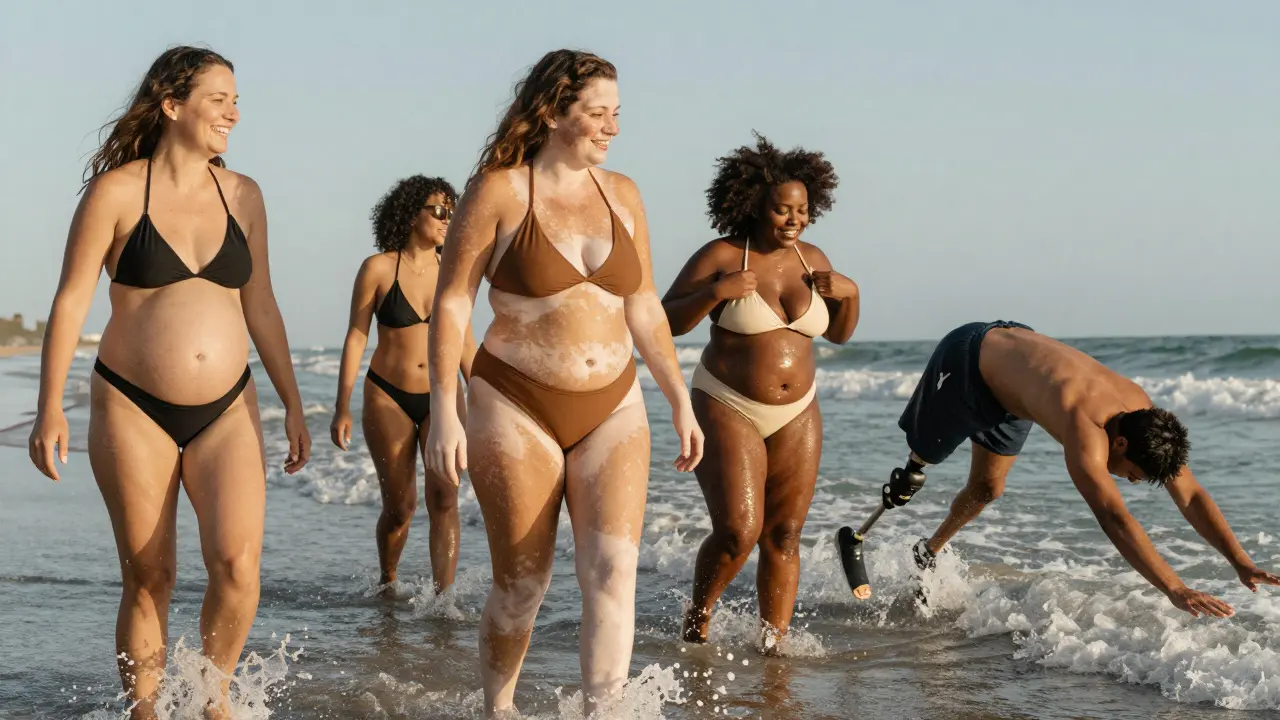
- Maternity models-women pregnant or postpartum, showing off their bodies without apology.
- Scarred and stretch-marked models-women who’ve had surgery, childbirth, or accidents, and now proudly wear their marks.
- Plus-size models of color-dark skin, natural hair, bold styles. No more "token" representation.
- Non-binary and gender-fluid models-breaking the binary, challenging norms, and redefining what "bikini" even means.
These aren’t niche trends. They’re mainstream. Brands like Savage X Fenty, Aerie, and even Victoria’s Secret now feature these models in their main campaigns-not as side notes, but as the face of the brand.
How Brands Are Changing
Remember when swimwear brands only made sizes up to 14? Now, companies like Girlfriend Collective and Reformation offer sizes from XXS to 5XL. Why? Because customers demanded it.
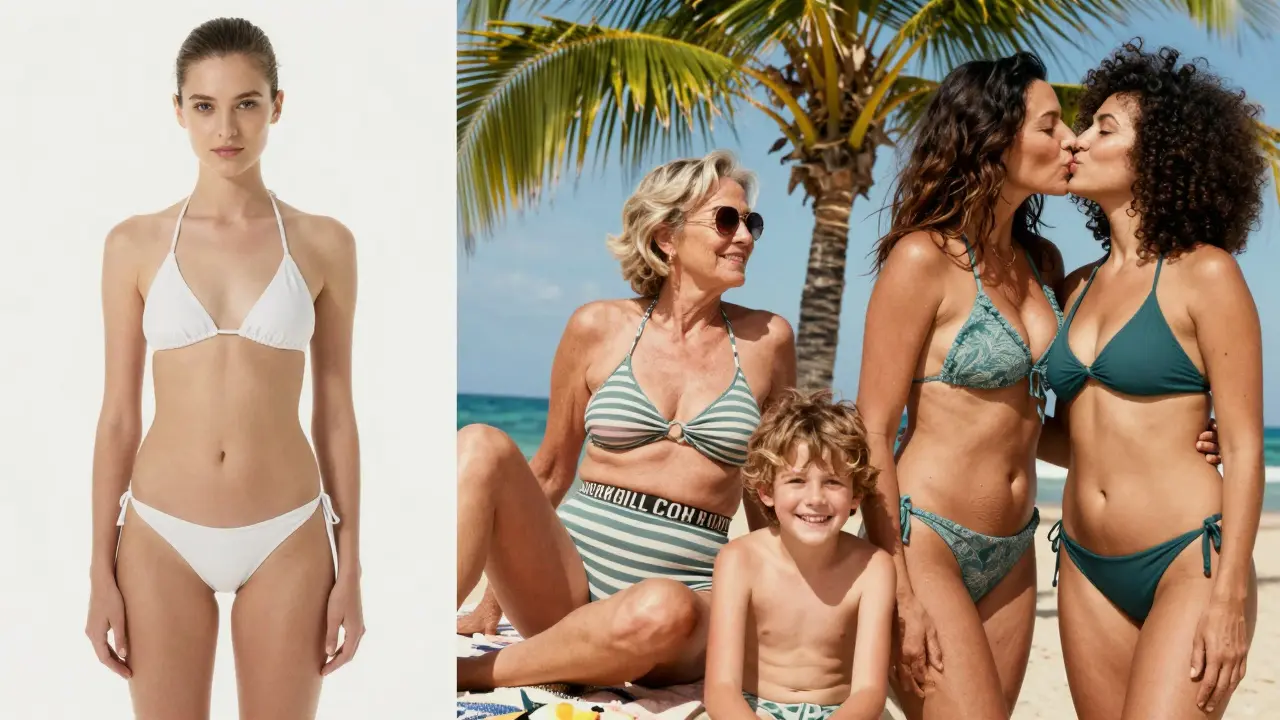
One brand, Lorna Jane, saw a 210% sales jump after launching a campaign featuring six models of different sizes, ages, and ethnicities-all wearing the same bikini. Their CEO said: "We stopped asking, ‘Who do we want to sell to?’ and started asking, ‘Who are we actually selling to?’" The answer? Real women. Not stereotypes.
And it’s not just about size. It’s about lighting. It’s about editing. More brands are ditching airbrushing. They’re leaving in freckles, dimples, and even the occasional pimple. Why? Because customers noticed. They said: "I don’t want a fantasy. I want a reflection."
What You’ll See in a Modern Bikini Shoot
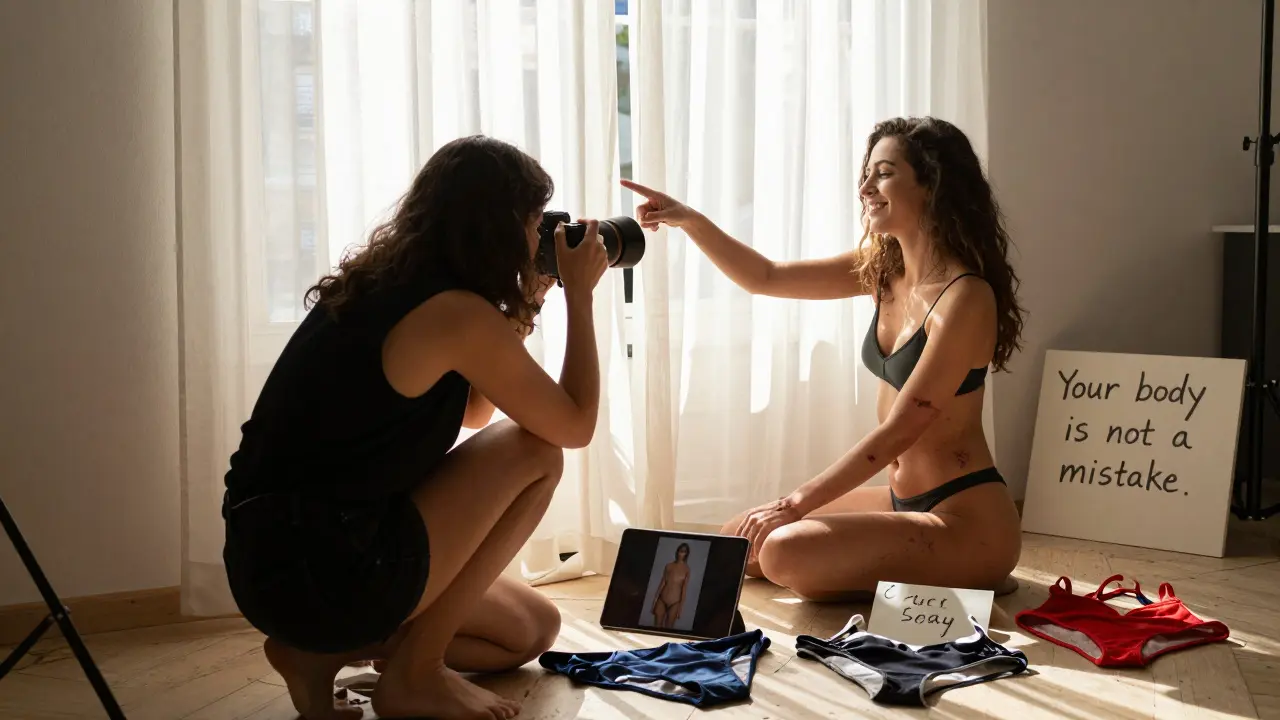
Forget the stiff poses and studio lighting. Today’s shoots feel more like a day at the beach with friends.
Models laugh. They adjust their straps. They splash water on their faces. They don’t smile on command-they smile because they’re having fun.
One shoot I saw in Lisbon (yes, I’ve been following this closely) had a model with vitiligo. The photographer didn’t try to "fix" her skin. He used natural sunlight to highlight the patterns. The result? A photo that looked like art. Not a product ad. Art.
Behind the scenes, crews are smaller. More women are directing. More models are co-creating the look. It’s less about perfection. More about personality.
How to Support This Shift
You don’t need to be a model to be part of this movement. Here’s how you can help:
- Follow models who show real bodies-not just the "ideal."
- Like, comment, and share posts that show diversity. Algorithms notice what you engage with.
- Call out brands that still use only one body type. Send them a polite message: "I’d love to see more sizes in your next campaign."
- Buy from brands that feature real people. Your wallet speaks louder than your words.
- Take a photo of yourself in a swimsuit-even if you don’t post it. Just for you. You deserve to see yourself, too.
What to Expect When You See a New Bikini Campaign
You won’t see perfect symmetry. You won’t see zero body hair. You won’t see the same face on every cover.
You’ll see:
- A woman with a C-section scar, grinning in a two-piece.
- A trans model wearing a bikini with her partner, both laughing.
- A 50-year-old grandmother in a high-waisted bikini, sunbathing with her grandkids.
- A woman with a prosthetic leg, diving into the ocean.
These aren’t "exceptions." They’re the new normal.
Comparison: Old vs. New Bikini Model Standards
| Aspect | Old Standard | New Standard |
|---|---|---|
| Body Type | Thin, toned, hourglass | Curvy, athletic, petite, plus-size, postpartum |
| Skin | Flawless, airbrushed | Real texture-stretch marks, freckles, scars |
| Lighting | Studio, filtered, high contrast | Natural light, candid moments |
| Editing | Smoothed, slimmed, whitened | Minimal to none. Embrace natural form |
| Representation | Primarily white, cisgender women | Multi-ethnic, LGBTQ+, disabled, older women |
| Message | "Look like this to be beautiful." | "You’re beautiful as you are." |
Frequently Asked Questions
Are bikini models still objectified?
Some still are-but not the ones making headlines anymore. The most talked-about bikini models today are also activists, entrepreneurs, and storytellers. They control their own image. They speak openly about consent, mental health, and body autonomy. The industry still has work to do, but the shift is real. The models who are gaining power are the ones who refuse to be reduced to just their body.
Can anyone become a bikini model today?
Yes-more than ever. Agencies are actively seeking models who don’t fit the old mold. You don’t need to be a size 0 or have perfect skin. You need confidence, authenticity, and a willingness to show up. Many start by posting their own photos on Instagram. If you’re real, people will notice.
Why do some brands still use the old style?
Some brands are slow to change. They think the old look sells better. But data says otherwise. Brands that switched to diverse models saw higher engagement, more sales, and stronger loyalty. The ones still clinging to the past? They’re losing ground. It’s not a trend-it’s a consumer revolution.
Is this just a Western trend?
No. From Lagos to Tokyo, women are demanding better representation. In Brazil, curvy models now headline national campaigns. In South Korea, women with acne are featured in swimwear ads. This isn’t about geography-it’s about humanity. People everywhere are tired of pretending.
Does this mean I have to wear a bikini?
Absolutely not. This isn’t about pressure-it’s about choice. If you love your swimsuit, wear it. If you don’t, wear a t-shirt over it. The goal isn’t to make you feel guilty for not showing skin. It’s to make you feel free to choose without shame.
Final Thought
Bikini models aren’t just posing in swimwear. They’re holding up a mirror-and asking us: "Do you recognize yourself in this?"
For too long, beauty was a gate. Now, the gate is wide open. And the people walking through? They look like you. They feel like you. They’re just not afraid to say it anymore.