

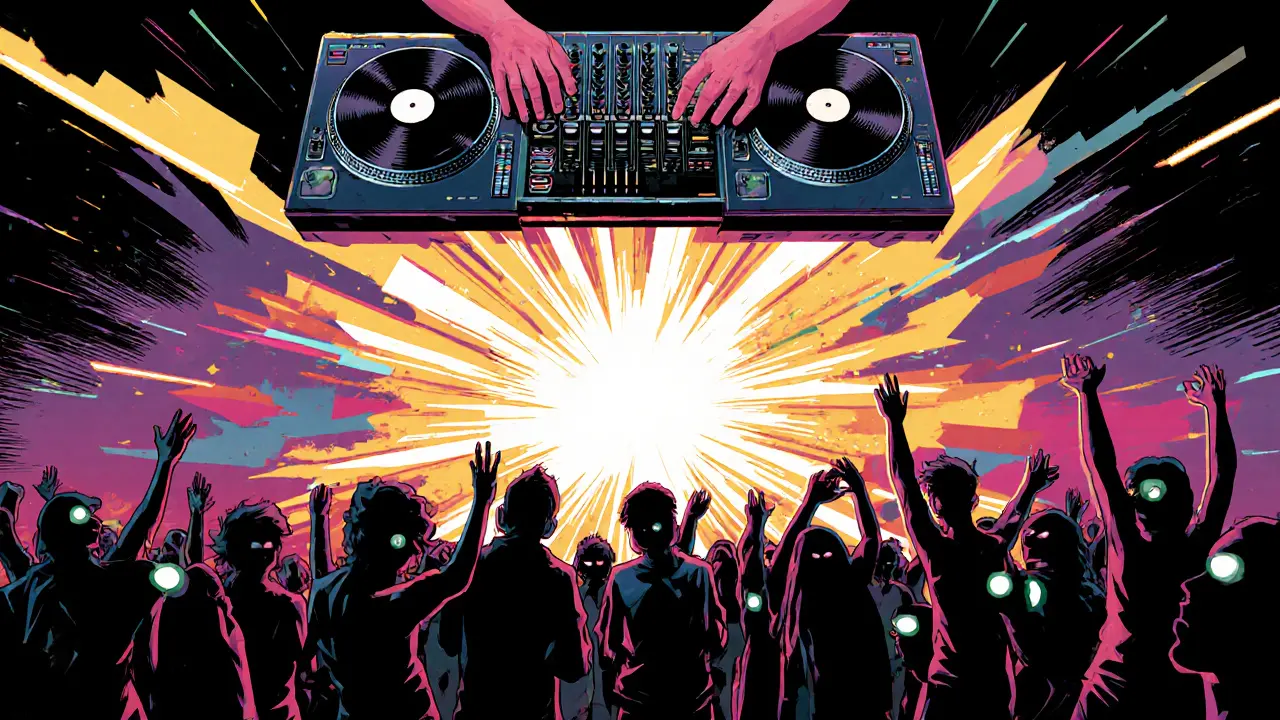
You walk in and the bass hits before you even see the lights. Your chest vibrates. Your feet move without you telling them to. That’s the magic of a night club night packed with beats-no explanation needed, just pure rhythm pulling you in. If you’ve ever stood in a packed club, sweat mixing with the glow of neon, lost in a drop that feels like it was made just for you, you know this isn’t just about dancing. It’s about connection, release, and sound that rewires your mood in seconds.
What Makes a Night Club Night Packed with Beats?
A night club night packed with beats isn’t just loud music. It’s about curated sound that moves through the room like a living thing. The DJ isn’t just playing tracks-they’re building a story. A slow build. A breath. Then-boom-the drop hits and the whole room exhales together. In 2025, the best clubs don’t just play house, techno, or hip-hop. They blend them. They let basslines ripple through the floor, let synths spiral above your head, and let vocal chops echo like ghosts in the dark.
Think of it like a rollercoaster made of sound. The pre-drop tension. The moment the kick enters. The way the crowd leans into it, arms up, eyes closed. That’s the heartbeat of a real club night. It’s not about how many people are there-it’s about how deeply the music connects.
Why This Matters in 2025
After years of lockdowns and muted venues, people aren’t just going out to drink. They’re going out to feel something again. And beats are the language that bypasses words. In Berlin, the bass in Berghain doesn’t just shake the walls-it shakes your stress loose. In Tokyo, underground clubs use sub-bass frequencies designed to resonate in your bones, not just your ears. In Miami, Latin rhythms fuse with electronic pulses, turning dancefloors into cultural melting pots.
A 2024 study by the International Club & Bar Association found that 78% of clubgoers aged 18-35 say they choose a venue based on the quality of the sound system, not the VIP list or bottle service. That’s huge. It means the music isn’t background noise anymore. It’s the main attraction.
Types of Beats You’ll Find on Club Nights
Not all beats are the same. The kind of night you have depends on the rhythm driving it.
- Techno: Minimal, hypnotic, relentless. Think industrial kicks, metallic hi-hats, and drones that build for 10 minutes before a single, earth-shaking drop. Best in Berlin, Detroit, or Amsterdam.
- House: Groovy, soulful, warm. Piano riffs, filtered vocals, and a steady 4/4 pulse that makes you move even if you’re just standing still. Think Chicago roots, now thriving in London and Ibiza.
- Hardstyle: Aggressive, distorted kicks, euphoric melodies. It’s the kind of beat that makes you jump without thinking. Popular in the Netherlands and Belgium, growing fast in Eastern Europe.
- Trap & Hip-Hop: Heavy 808s, skittering snares, triplet flows. If you like bass that rattles your teeth, this is your zone. Dominant in Atlanta, Los Angeles, and now in underground spots in Paris and Barcelona.
- Latin Club: Reggaeton, dembow, Afrobeat hybrids. Percussion-driven, danceable, and full of energy. Think Puerto Rico meets Madrid, with DJs mixing Bad Bunny with deep house.
Some clubs specialize. Others mix. The best nights happen when a techno DJ drops a trap beat just when the crowd’s ready for it-and everyone loses their minds.
Where to Find the Best Beats in 2025
It’s not just about the city. It’s about the venue, the night, and the time you show up.
- Berlin: Berghain on Saturday night. Doors open at 10 PM. No dress code. No VIP. Just pure sound. The system? 300+ speakers, custom-built. You don’t leave until the music ends.
- London: Printworks (now reopened) for industrial techno. Fabric for classic house. The Warehouse Project in Manchester for experimental sets.
- Miami: LIV on Friday nights for high-energy hip-hop and Latin fusion. Story for deep house and disco.
- Tokyo: Womb and Ageha for underground techno. The beats here are precise-engineered, not random. You feel every frequency.
- Amsterdam: De School for raw, no-frills techno. The basement has a floor that vibrates under your feet. You’ll know it when you’re there.
Pro tip: Don’t just check the lineup. Check the sound engineer. The best clubs have dedicated audio teams who calibrate the system for each DJ. That’s why the same track sounds different at Club A vs. Club B.
What to Expect When You Walk In
It’s not just the music. It’s the whole atmosphere.
You’ll smell incense, sweat, and maybe a hint of spilled beer. The lights don’t flash-they pulse. Slow reds, deep blues, strobes that feel like heartbeats. The crowd? Not just partygoers. They’re believers. People who came to escape, to feel, to lose themselves. You’ll see someone crying in the corner, dancing alone. Someone else laughing, arms around a stranger. That’s the club. It’s not about who you know. It’s about what the music makes you become.
Sound systems in top clubs now use 3D audio tech-speakers placed to create moving sound waves. A synth might start behind you, swirl around your head, then vanish into the crowd. It’s not gimmick. It’s immersion.
Pricing and Booking
Most clubs don’t require tickets in advance unless it’s a special event. Cover charges range from €15-€40 in Europe, $20-$60 in the U.S., depending on the night and location.
Weeknights? Often free or under €10. Friday and Saturday? Expect to pay more-and wait in line. Some clubs use apps like Resident Advisor or Bandsintown to list events and sell tickets. Others just show up and pay at the door.
Pro tip: Arrive early. First hour is often the best. The crowd’s still building. The sound is clean. The DJ’s testing new tracks. You get the full journey.
Safety Tips for Club Nights
Beats are powerful-but so is the environment.
- Stay hydrated. The air’s dry, the lights are hot, and you’re moving nonstop.
- Keep your phone in a secure pocket. Pickpockets love crowded dancefloors.
- Never leave your drink unattended. Even if you trust the person next to you.
- Know your exit. Map the nearest door before you get lost in the music.
- Travel with a friend-or at least check in with someone hourly.
- Don’t feel pressured to take anything. If someone offers you something, say no. Your night is yours.
Most clubs now have free water stations and security teams trained in de-escalation. Look for staff wearing bright vests. They’re there to help.
Club Beats vs. Festival Beats
| Feature | Club Beats | Festival Beats |
|---|---|---|
| Sound System | Custom-built, precise, immersive | Large but distant, designed for crowds |
| Duration | 8-12 hours, continuous flow | 3-6 hours per set, scheduled breaks |
| Atmosphere | Intimate, intense, personal | Collective, massive, overwhelming |
| DJ Interaction | High-DJ reads the room, adapts in real time | Low-sets are pre-planned, less flexibility |
| Best For | Deep connection, musical discovery | Energy, spectacle, group experience |
Clubs are about depth. Festivals are about scale. One makes you feel alone in a crowd. The other makes you feel part of a movement. Both are valid. But if you want to hear music like it was meant to be heard-close, raw, alive-clubs win.
Frequently Asked Questions
What should I wear to a night club with packed beats?
Dress for movement, not for looks. Comfortable shoes are non-negotiable. Most clubs don’t enforce strict dress codes anymore-just avoid flip-flops and overly baggy clothes that get in the way. Black is always safe. But if you want to stand out, try metallic fabrics or bold accessories. The music will do the rest.
Can I go to a night club alone?
Absolutely. In fact, many regulars do. You’ll find people dancing alone, sipping drinks at the bar, or just standing near the speakers feeling the bass. No one’s judging. If you’re there for the music, you’re already part of the scene. Just stay aware, keep your phone charged, and trust your gut.
How do I know if a club has good sound quality?
Walk in during a set. Listen to the low end. If the bass sounds muddy or distant, it’s not good. Good systems make you feel the kick in your chest, not just your ears. Check if the venue has a reputation for sound engineering. Clubs like Berghain, Fabric, or Womb invest in custom setups. They’re worth the wait.
Are night clubs still popular in 2025?
More than ever. After the pandemic, people crave real, physical experiences. Music is the glue. Clubs have adapted with better sound, safer spaces, and more inclusive vibes. The crowds are diverse, the music is evolving, and the energy? It’s electric.
What’s the difference between a DJ set and a live performance in a club?
A DJ set uses pre-recorded tracks, mixed live. A live performance means the artist is creating music in real time-using synths, drum machines, or controllers. Live sets are rarer in clubs, but when they happen, they’re unforgettable. You’ll hear things no one else has heard before.
Ready to Feel the Beat?
Don’t wait for the perfect night. There’s no such thing. The best club nights happen when you show up, even if you’re tired, even if you’re unsure. The music doesn’t care if you’re new. It just wants you to move. Find a club near you. Check the lineup. Go early. Let the bass pull you in. And for once, don’t think. Just feel.




Piotr Williams
Okay, but can we talk about how every single club article since 2020 says the same thing? "The bass hits before you see the lights"-yeah, we get it. It’s a bass. It’s loud. You’re vibin’. I’ve read this exact paragraph 17 times. Also, why does every writer feel the need to describe the "ghostly vocal chops"? Who talks like that? I went to a club last week. The DJ played "Uptown Funk." Everyone danced. Someone puked in the corner. The end.
Matt H
Bro, you’re underselling the sonic architecture here. This isn’t just ‘beats’-it’s spatial audio engineering meets neuroacoustic entrainment. Top-tier clubs in 2025 are deploying adaptive FIR filters, real-time room correction via AI-driven mic arrays, and subharmonic synthesis tuned to human resonance frequencies (40-80Hz). That’s not ‘bass’-that’s somatic calibration. The 78% stat? Understated. The real metric is retention time: how long your autonomic nervous system stays in flow state post-exit. That’s the KPI. And yeah, Berghain’s 300-speaker array? Still the gold standard. No one else comes close.
Ashok Sahu
I grew up in Mumbai listening to house music in tiny basements with speakers held up by bricks. Back then, we didn’t have fancy sound systems-we had passion. Now I see kids in Berlin crying because a kick hit just right, and I’m like… we’ve been here. The rhythm doesn’t care where you’re from. What matters is you showed up. Whether it’s a basement in Delhi with a Bluetooth speaker or a club in Miami with 3D audio-it’s the same heartbeat. Just let the music take you. No need to overthink it. And hey, if you’re going out alone? You’re not weird. You’re brave.
Vincent Jackson
Man, I went to this little spot in Philly last Friday-no name, just a door with a red light. Sound system was kinda crackly, but the DJ dropped this old-school Detroit techno track with a trap snare layered under it? I swear, the whole room just… stopped. Then exploded. No fancy tech, no VIP section, just pure vibe. Also, side note: why do people always say ‘the bass hits your chest’? I felt it in my teeth. Like, literally. My fillings were vibrating. Anyway, if you’re gonna go out, go early. First hour is always the real one. The rest is just noise.
Jason Hancock
LMAO. ‘The music rewires your mood’? That’s the most pretentious thing I’ve read since someone called a TikTok dance ‘postmodern choreography.’ You think Berghain’s magic? Try going to a club in Ohio where the DJ is a guy named Dave who plays ‘Crazy Frog’ and ‘Never Gonna Give You Up’ on loop. The crowd loves it. The bass doesn’t ‘shake your stress loose’-it just makes you tired. And who cares about ‘sound engineers’? If you can’t dance to a track because it’s not ‘custom-calibrated,’ you’re not at a club-you’re at a TED Talk with strobe lights. Also, ‘Latin fusion’? Bro, it’s just reggaeton with a side of EDM. Stop romanticizing it.
Jill Norlander
While the emotional appeal of club culture is undeniably compelling, the article exhibits a concerning lack of empirical rigor. The claim that ‘78% of clubgoers choose venues based on sound quality’ is cited without a peer-reviewed source, and the reference to the ‘International Club & Bar Association’ is unverifiable. Furthermore, the conflation of subjective experience with objective auditory science-such as describing bass as ‘rewiring mood’-is pseudoscientific. A responsible publication would provide data from acoustical engineering studies, not poetic metaphor. The safety tips, while adequate, are superficial. Where is the discussion on noise-induced hearing loss? The CDC recommends 85 dB limits for prolonged exposure; many clubs exceed 110 dB. This piece glorifies risk without accountability.