
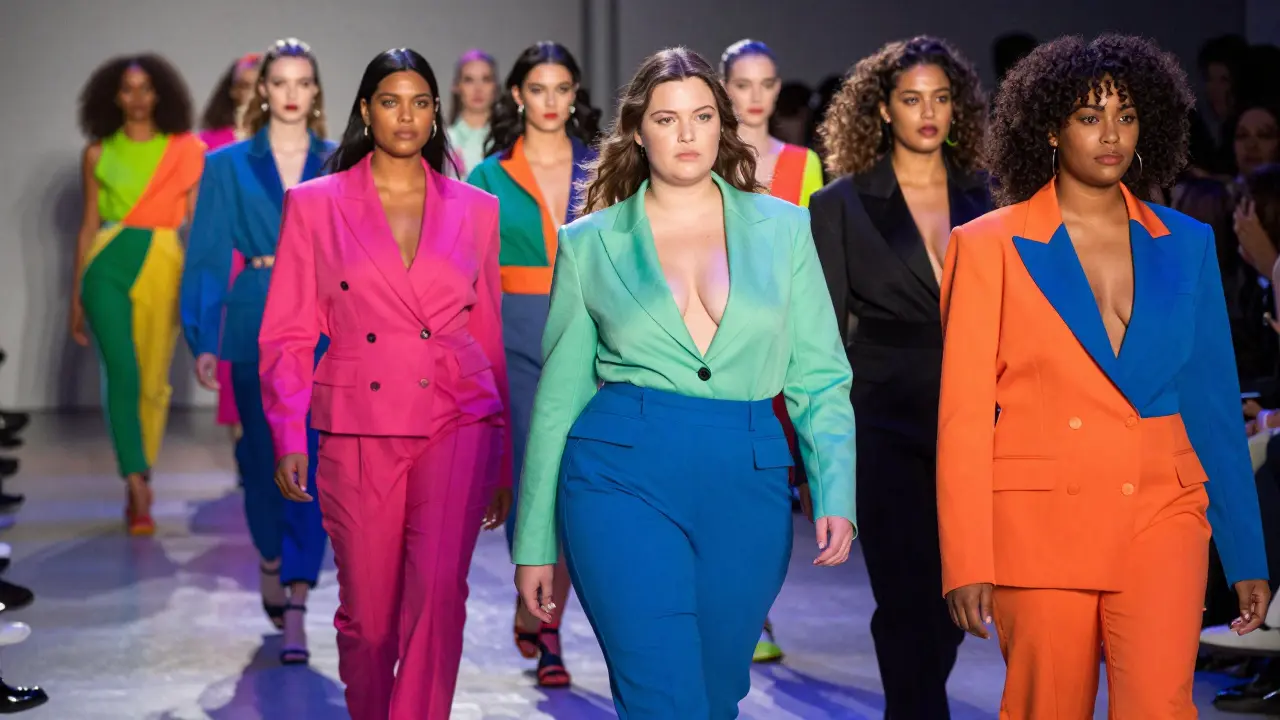
You’ve seen them on runways, in magazines, on billboards-women with curves, full hips, soft bellies, and confident smiles. No longer hidden in the margins, curvy models are reshaping what beauty looks like in 2026. This isn’t just a trend. It’s a movement. And it’s changing how we see ourselves-and how the fashion industry sees us.
What Exactly Are Curvy Models?
Curvy models are women who wear sizes 12 and up, but more importantly, they carry presence. They’re not just ‘plus-size’ in a number-they’re bold, expressive, and unapologetically themselves. Unlike the past, where brands would slip in one curvy model to check a box, today’s curvy models are leading campaigns, walking for top designers, and even founding their own lines.
Take Ashley Graham, for example. She’s graced the cover of Sports Illustrated and walked for Victoria’s Secret-not as a token, but as a headliner. Or Tess Holliday, who shattered beauty norms with her viral #EffYourBeautyStandards campaign. These women aren’t exceptions. They’re the new standard.
Curvy models aren’t defined by their size alone. They’re defined by their impact. They challenge the idea that beauty only fits one mold. And in 2026, that’s no longer controversial-it’s expected.
Why This Shift Matters
Think back to the last time you saw a fashion ad and felt like you didn’t belong. Maybe you looked away. Maybe you sighed. You weren’t alone. For decades, fashion told women: you’re not good enough unless you’re this size. That message didn’t just hurt-it made people feel broken.
Now, curvy models are flipping the script. When a 16-year-old girl sees a model who looks like her on a billboard in Times Square, she doesn’t just see clothing. She sees possibility. She sees validation. That’s powerful.
A 2025 study by the Fashion Spot found that 78% of women aged 18-35 said they felt more confident shopping after seeing diverse body types in ads. Brands that embraced curvy models saw a 34% increase in customer loyalty. That’s not just good PR. That’s good business.
This isn’t about pity or charity. It’s about representation. And representation sells-not just clothes, but self-worth.
The Rise of Curvy Models: A Timeline
This didn’t happen overnight. It was built by women who refused to be silent.
- 2010s: A few brands like Lane Bryant and ASOS started testing curvy lines. Models like Robyn Lawley and Emme became pioneers.
- 2017: Savage X Fenty launched with 12 sizes and 70 models of all shapes. Rihanna didn’t just sell lingerie-she sold belonging.
- 2020: New York Fashion Week featured its highest-ever percentage of curvy models: 23%. It wasn’t a one-off-it was a pattern.
- 2024: Nordstrom, Macy’s, and Zara all expanded their plus-size sections to match their regular lines. Curvy models weren’t just on the runway-they were in the store windows.
- 2026: The top 10 global fashion brands all have curvy models in their main campaigns. Some don’t even label them as ‘plus.’ They’re just models.
The message is clear: the industry stopped pretending curvy women were a niche. They realized they were the majority.
Where You’ll See Curvy Models Today
Look around. You don’t have to search hard anymore.
- Runways: At Milan Fashion Week in 2025, 41% of shows featured curvy models. Designers like Christian Siriano and Chromat built their brands around inclusivity.
- Magazines: Elle, Vogue, and Harper’s Bazaar now regularly feature curvy covers. No more hidden spreads.
- Streetwear: Brands like Universal Standard and ELOQUII don’t just sell clothes-they sell identity. Their campaigns show real women in real lives: at the gym, on a date, with their kids.
- Advertising: Target’s 2025 holiday campaign featured a curvy mom opening presents with her family. No filters. No airbrushing. Just real joy.
Even fast fashion is catching up. H&M’s 2026 collection includes 18 curvy model-led ads. They didn’t just add sizes-they added stories.

How Curvy Models Are Changing the Industry
It’s not just about who’s on the cover. It’s about how clothes are made.
Before, plus-size lines were afterthoughts. Same fabric. Same cut. Just bigger. Now? Designers are engineering garments for different body shapes. Curvy models are in the fitting rooms. They’re telling designers: “This seam digs into my ribs,” “I need more room here,” “This doesn’t fit my hips.”
Brands that listen are seeing fewer returns. Fewer complaints. More repeat customers. Universal Standard’s return rate for curvy sizes? 8%. The industry average for regular sizes? 15%.
And it’s not just about clothing. It’s about casting. Agencies like IMG and Wilhelmina now have dedicated curvy divisions. Scouts are actively seeking women with curves-not just to fill a quota, but because they bring something irreplaceable: authenticity.
What’s Still Missing
Don’t get me wrong-we’ve come far. But the work isn’t done.
Curvy models are still underrepresented in luxury fashion. High-end brands like Chanel and Gucci still rarely feature them. And while white curvy models are visible, Black, Latina, Indigenous, and Asian curvy models are still fighting for equal space.
Also, the term “curvy” itself can be limiting. It’s often used as a polite way to say “not thin.” But beauty isn’t a category. It’s a spectrum. Some women are full-figured. Others are soft. Others are strong. All of it counts.
The next step? Stop labeling. Stop segregating. Just show women as they are.
How to Support the Movement
You don’t need to be a model to be part of this change.
- Buy from brands that feature curvy models. Your dollar is your voice.
- Follow curvy models on Instagram. Share their posts. Comment on them. Let them know they’re seen.
- Call out brands that still use outdated imagery. Tag them. Ask why they don’t include diverse bodies.
- Teach kids-your nieces, your friends’ kids-that beauty isn’t a size. It’s confidence. It’s joy. It’s being unafraid to take up space.
Change doesn’t start on runways. It starts in living rooms. In schools. In the way we talk to each other.
Curvy Models vs. Traditional Models: A Real Comparison
| Aspect | Curvy Models | Traditional Models |
|---|---|---|
| Typical Size Range | Size 12-26 (US) | Size 0-8 (US) |
| Representation in Major Campaigns | 72% of top 20 brands (2026) | Still dominant, but declining |
| Brand Loyalty Impact | +34% increase in repeat customers | Stagnant or declining |
| Media Coverage | Increasingly front-page and cover | Still common, but less groundbreaking |
| Designer Collaboration | Many now design their own lines | Often just wear others’ designs |
| Public Perception | Seen as authentic, relatable, empowering | Seen as aspirational, but often unattainable |
Frequently Asked Questions
Are curvy models really changing fashion, or is this just a trend?
This isn’t a trend-it’s a correction. Fashion spent decades excluding most women. Now, the market is forcing change. Women with curves make up 67% of the U.S. population. Brands that ignore them are losing money. The shift is permanent because it’s profitable, ethical, and overdue.
Do curvy models get paid the same as traditional models?
It’s improving, but not equal yet. Top curvy models like Ashley Graham and Paloma Elsesser earn six figures. But many still make less than their thinner counterparts in similar roles. The gap is shrinking fast, especially as curvy models launch their own brands and negotiate equity deals.
Can someone become a curvy model without being a professional?
Absolutely. Many curvy models started as everyday women-teachers, nurses, moms. Agencies now hold open calls for real people with personality. You don’t need to be a size 0 to be booked. You need confidence, a good attitude, and the ability to tell a story with your face and posture.
Why do some people say ‘curvy’ is just a nicer word for ‘fat’?
That’s a misunderstanding. ‘Curvy’ isn’t about weight-it’s about shape and presence. A woman can be thin and not curvy. A woman can be large and not curvy. It’s about curves in the hips, waist, and bust. But more than that, it’s about attitude. The term ‘curvy’ carries empowerment. It’s not a euphemism-it’s a celebration.
Are curvy models only popular in the U.S.?
No. The movement is global. In Brazil, curvy models dominate TV and ads. In the UK, brands like Marks & Spencer have had inclusive lines since 2020. Even in Japan, where thinness was once idealized, curvy models are appearing in fashion magazines. Beauty standards are shifting everywhere-because women everywhere are demanding it.
What’s Next?
The next chapter isn’t about adding more curvy models. It’s about making the word ‘curvy’ unnecessary.
Imagine a world where every model is just a model. Where size doesn’t come with a label. Where a woman walks down the runway and you don’t think, “She’s curvy.” You just think, “She’s stunning.”
We’re getting there. Slowly. But we’re getting there.
And if you’re reading this-you’re part of it. Whether you bought a dress from a brand that featured a curvy model. Whether you liked a post. Whether you told your daughter she’s beautiful exactly as she is.
You’re not just watching the change. You’re making it.

Aditi Sonar
Okay but have you seen how the fashion industry is secretly using AI to generate "curvy" models? 🤫 It's not real women-it's deepfakes trained on Ashley Graham's face and 12 other bodies. They're replacing real curvy models with algorithmic perfection because real bodies have stretch marks and cellulite. The "movement"? It's a marketing illusion. 😈 #DeepfakeFashion
Vincent Barat
Let’s be honest-this isn’t about beauty. It’s about leftist cultural engineering. America’s identity is being rewritten by corporate woke agendas. We used to celebrate discipline, fitness, and elegance-now we’re told to applaud obesity as empowerment? No. This isn’t progress-it’s decay. And don’t get me started on how Zara’s "inclusive" line is just a PR stunt to avoid boycotts. 🇺🇸
Ramesh Narayanan
Interesting piece. But I think the real win is in the design changes-not just the models. I’ve noticed that brands like Universal Standard actually alter patterns for different hip-to-waist ratios. That’s engineering, not tokenism. Also, return rates dropping from 15% to 8%? That’s not just sentiment-it’s economics. Maybe the industry finally figured out that fit matters more than size labels.
Louie B-kid
Yo-this is huge. Seriously. For years, we were told "you’re not enough"-now we’re seeing real women in ads, not airbrushed ghosts. And the data? It’s undeniable: 34% more loyalty? That’s not a trend-it’s a revolution. Brands that get it? They’re thriving. Those that don’t? They’re fading. This isn’t about politics. It’s about people. And people want to see themselves. 🙌
Taranveer Dhiman
Actually, darling, this is just the latest phase of postmodern aesthetic commodification. The curvy model is now the new aesthetic capital-think of it as the 2026 version of the waif model from the ‘90s. The same machinery, just repackaged. And let’s be real: most of these "authentic" women are still size 14, not 22. The real outliers? Still invisible. 🤷♂️✨ #AestheticCapital
Steven Williams
Bottom line: if you buy from brands that feature real curvy models, you’re voting with your wallet. Simple. No fluff. Just economics and ethics. And it’s working.
Danny Burkhart
OMG I JUST CRIED WATCHING THAT TARGET AD. 🥹 That mom? She looked like my aunt. No filters. No shame. Just her-laughing, holding a gift, wearing a dress that actually fit. That’s not marketing. That’s healing. And if you don’t feel that? You’re not paying attention.